• Work
  • Educational collaborations
  • Blog
  • Bio
  • Contact
Menu

Rachel Davis

PAINTINGS, PRINTS, and TEXTILES
  • Work
  • Educational collaborations
  • Blog
  • Bio
  • Contact
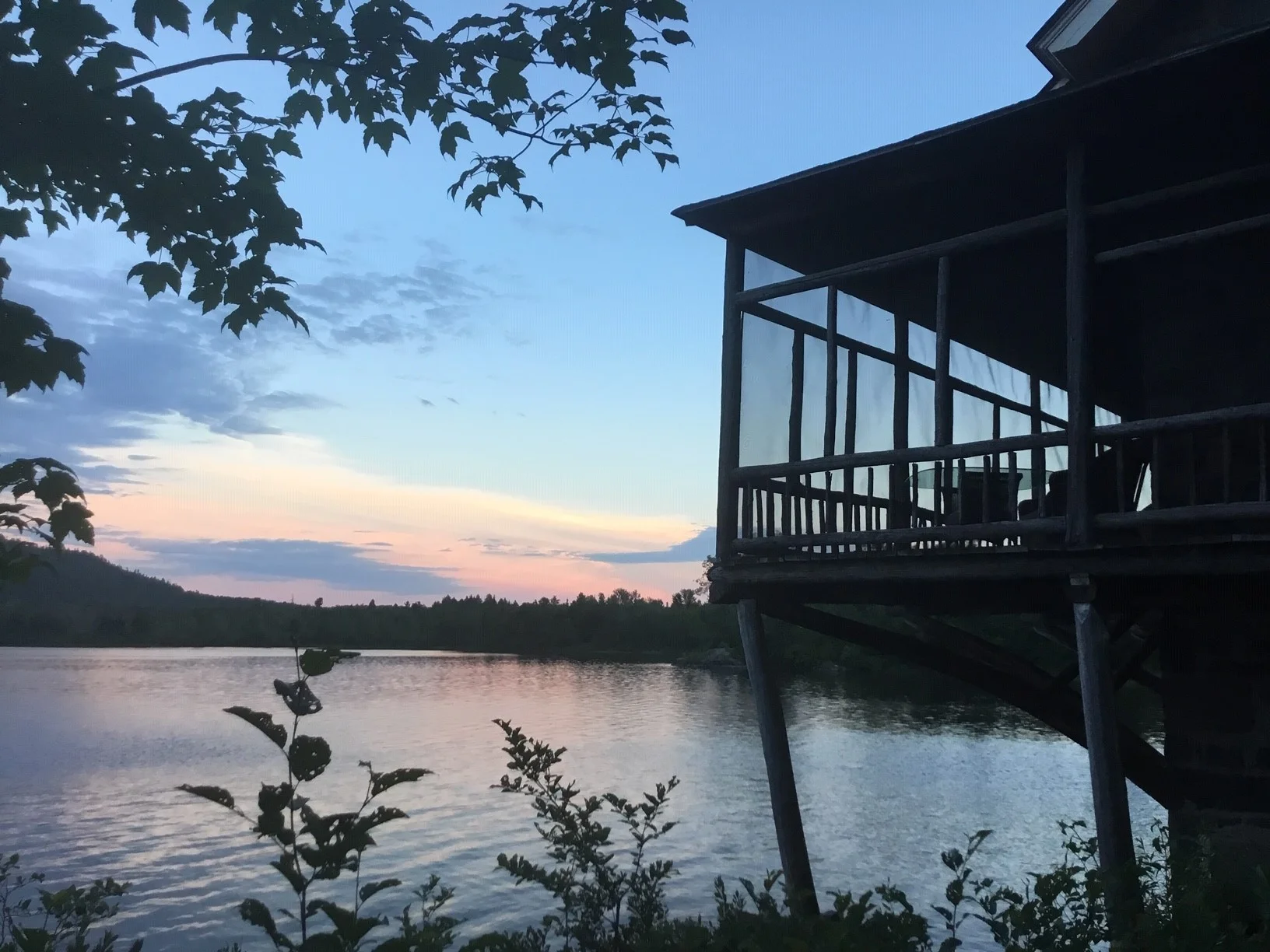
Porch_Stone_House.jpg

Huron Mountain Wildlife Foundation: Artist-in-Residence, 2019

September 2, 2019

I had the good fortune to be awarded an Artist-in-Residence by the Huron Mountain Wildlife Foundation (HMWF) for one week in late July. The HMWF supports field-based research on roughly 20,000 acres that enclose nine lakes on the south shore of Lake Superior. In 2019, the Foundation extended their invitation to include visual artists; an excerpt from their call for artist-in-residence reads:

          HMWF researchers work in one of the most striking landscapes in eastern North America, and their work often addresses organisms and systems that, in addition to being unusual or rare, are of great esthetic appeal and striking visual (or other sensory) impact.

My residency was located at the Ives Lake Field Station in the Huron Mountains. The Stone House was my home and studio for the week, and I shared the space with scientists doing field research. Two features of the Stone House impressed me. On the first floor there is a library of scientific texts and field guides. These are the types of books I seek out as a starting point in my artistic practice. Their subject matter includes slime mold, spores, fungi, aquatic invertebrates, mosses, lichens, leeches, and more. The second feature of the Stone House was the nearly forty-foot long porch that hangs over Ives Lake. The porch served as my studio for the duration of my residency. I explored the confines of the Field Station: I paddled on Ives and Pine Lakes; hiked the Breakfast Roll and Mountain Stream trails; and visited Flat Rock to see Lake Superior and the Huron Islands. I did not exhaust the 20,000 acres of the Huron Mountains by any means, but I did discover and study a myriad of aquatic plants, mosses and insects I had never seen as well many kinds of fungi and lichen. Throughout, I travelled and observed in the company of Bald and Golden Eagles and Loons. Does it get any better?

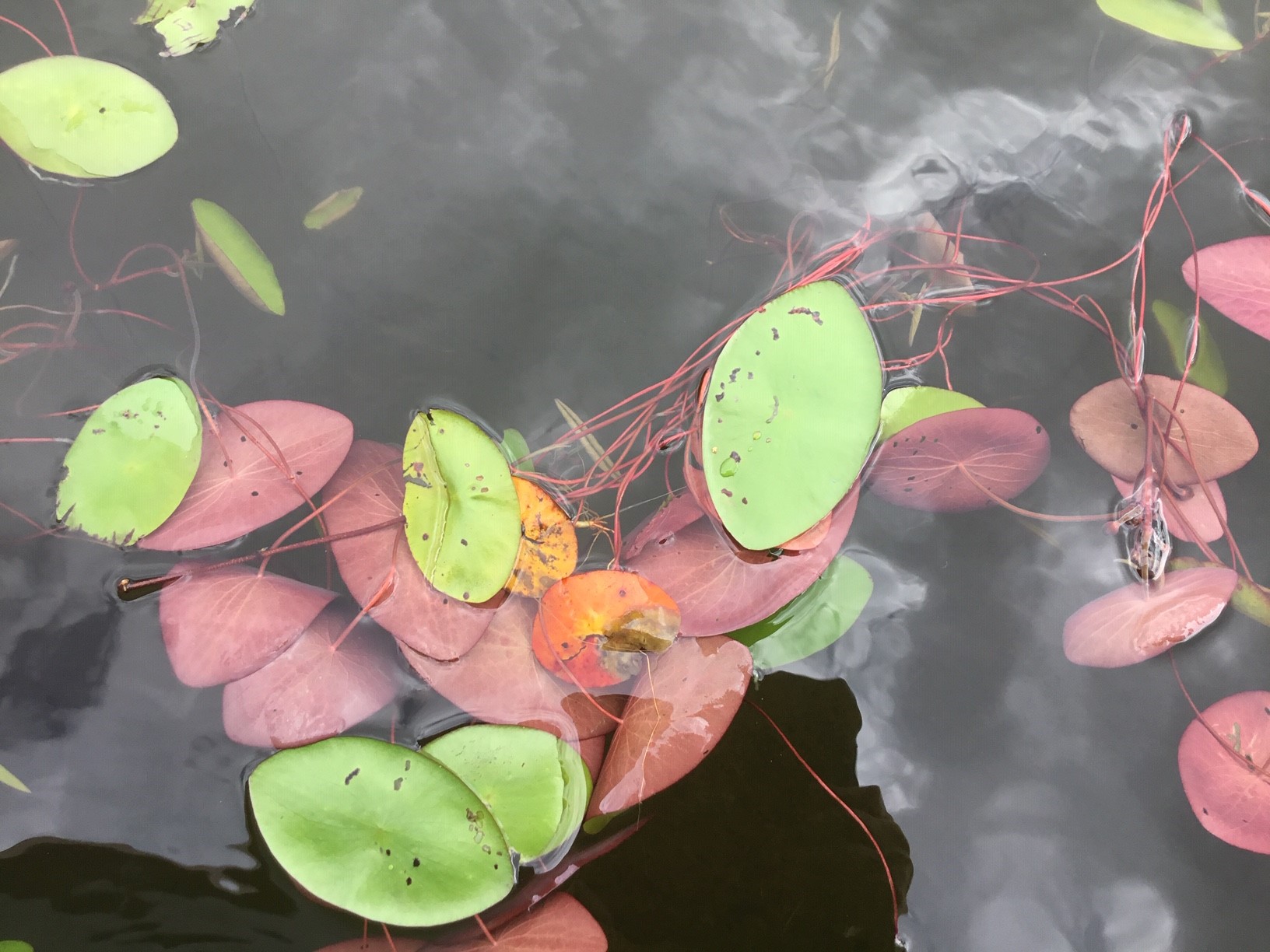
I had received a list of scientists doing field work at Ives Lake. Among the researchers was Susan Knight of University of Wisconsin-Madison. Susan and her team were continuing an ongoing study of aquatic plants that grow in large rings, referred to as fairy rings, on Howe Lake. This work appealed to me aesthetically, and I corresponded with Susan and made plans to accompany her in the field. The fairy rings were an impressive sight, measuring over 30 meters across. On our visit to collect water specimens, Susan showed me the gelatinous film on the undersides of water shield and their pink blossoms. Her team ran a drone to photograph the rings from above.

Scientists and artists have much in common in the ways they work. We noticed we both carried a diverse set of supplies and tools with us into the field. Researchers carried black lights for seeing Caddis flies, peepers to collect water samples and buckets and Ziploc bags to collect aquatic plants, blueberries or fungal flowers. They recorded the exact location, temperature, time of day and utilized both submersible drones and air drones to document their process. I carried crates of plywood panels to paint on, sandpaper, ink, portfolios with paper and an iPad to document my process. Artists and scientists both spend the majority of their time observing the world around them, collecting data, and evaluating their data. Over a decade ago I collaborated with my husband, the botanist Andrew Hipp, on a Field Guide to Wisconsin Sedges. I illustrated over 150 species of Carex, the seed, flower and whole plant. I did this while looking at herbarium specimens and specimens under magnification. Botanical illustration is one dimension of the work that I make as an artist. Another aspect of my work is to alter things I’ve seen in nature and radically change their size and color in order to experiment with composition and design. In this body of work, I am not concerned with whether the starting point looks like its conclusion.

Artists often set off in new directions because of some tangential interest or discovery. Scientists, I found, do as well. A few days into my residency Ericka Hersch-Green of Michigan Technological University arrived at the Stone House to study fungal flowers that she had discovered on blueberry and huckleberry leaves. This pursuit came as a tangent when she was doing fieldwork on blueberries. I also found that unexpected changes in the weather and interruptions by people or animals are common outside factors that provide challenges to both scientists and artists. They often provide opportunities as well.

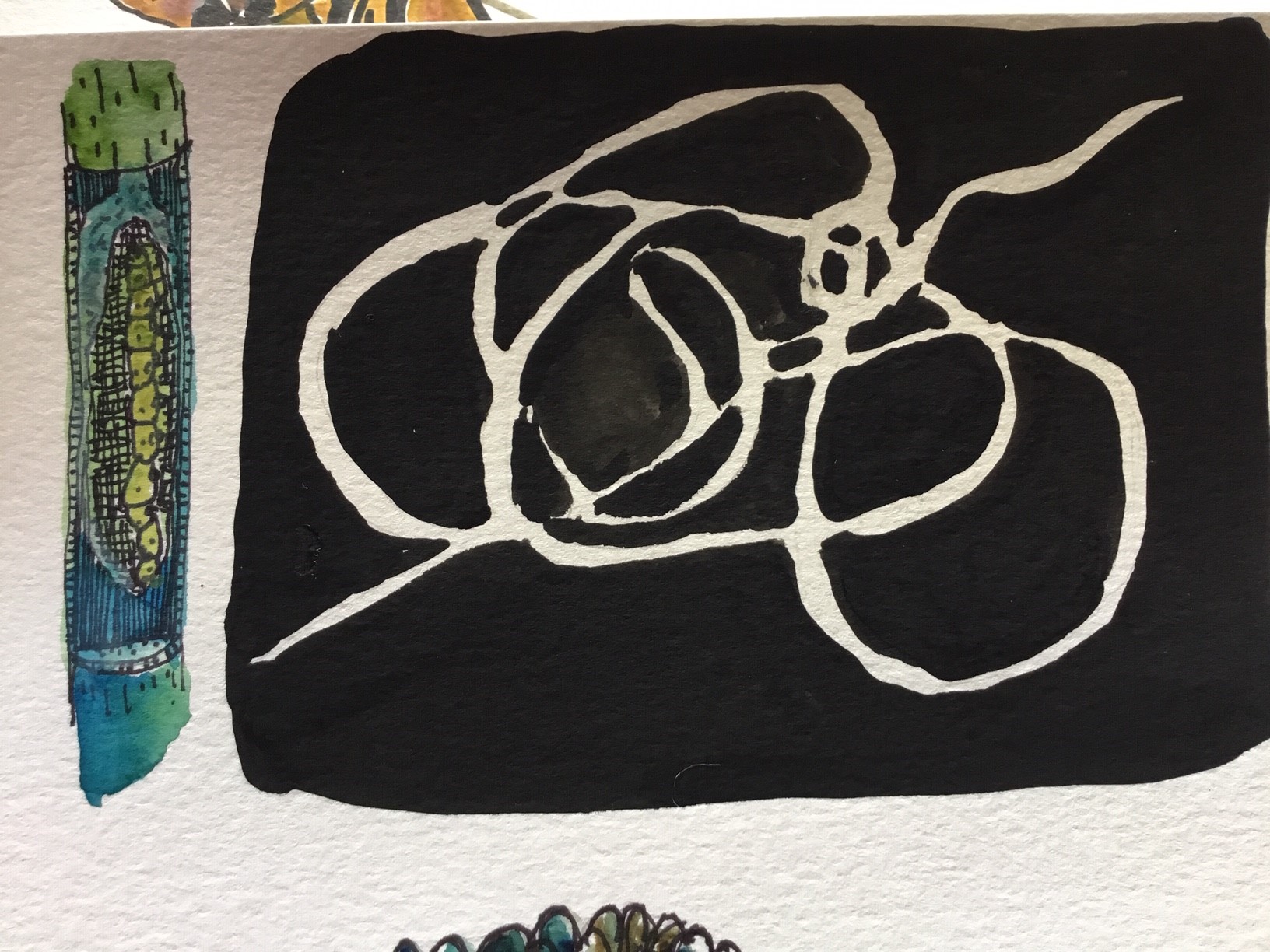
One day a few kids from the Huron Mountain Club came to Ives Lake to swim and found a dazed dragonfly. While they were taking turns holding it, a Horsehair worm emerged from the dragonfly. I loved the kids’ reaction: the kids came running to the station to ask what is was. They were not grossed out, just fascinated. A researcher and I were not certain of what they had found, but we soon figured out it was a Horsehair worm. Horsehair worms are ingested by grasshoppers and dragonflies as a pre-parasitic cyst. After ingestion the cyst grows an immature parasite that feeds on its host until it reaches maturity. Then it emerges through the skin of the host and returns to the water. The kids ended up giving the specimens to the Huron Mountain Club Museum. This brief moment, maybe 25 minutes from when the kids brought their specimen to us to when they departed, informed my art making for the remainder of the week and became a formal element in my paintings and drawings. Artistically, this parasite represents a thin, white, line; a gesture; a tangle that refers to a thread, a knot. I anticipate I will continue this body of work in my home studio and that this subject matter will be central in new textile work.

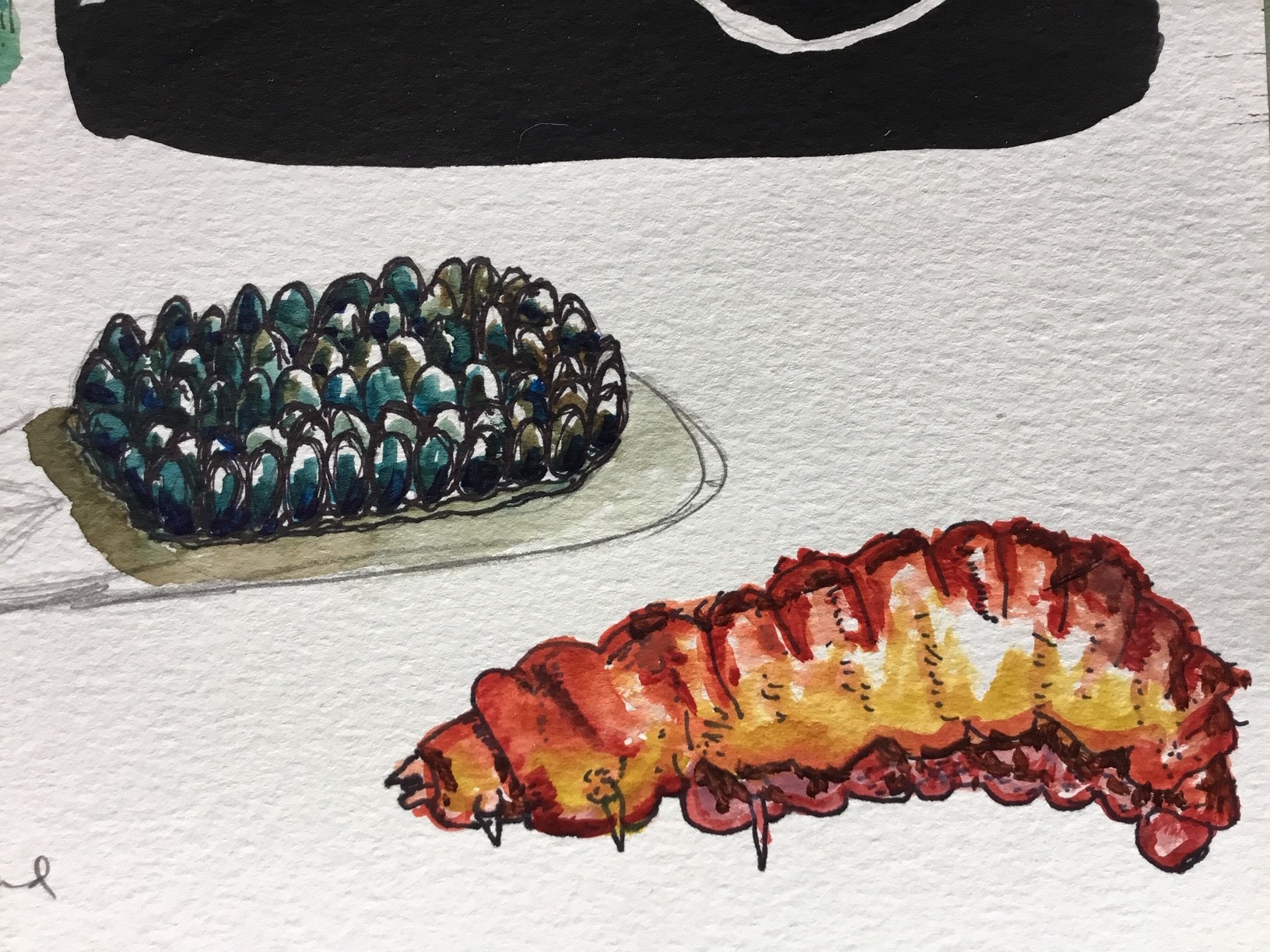
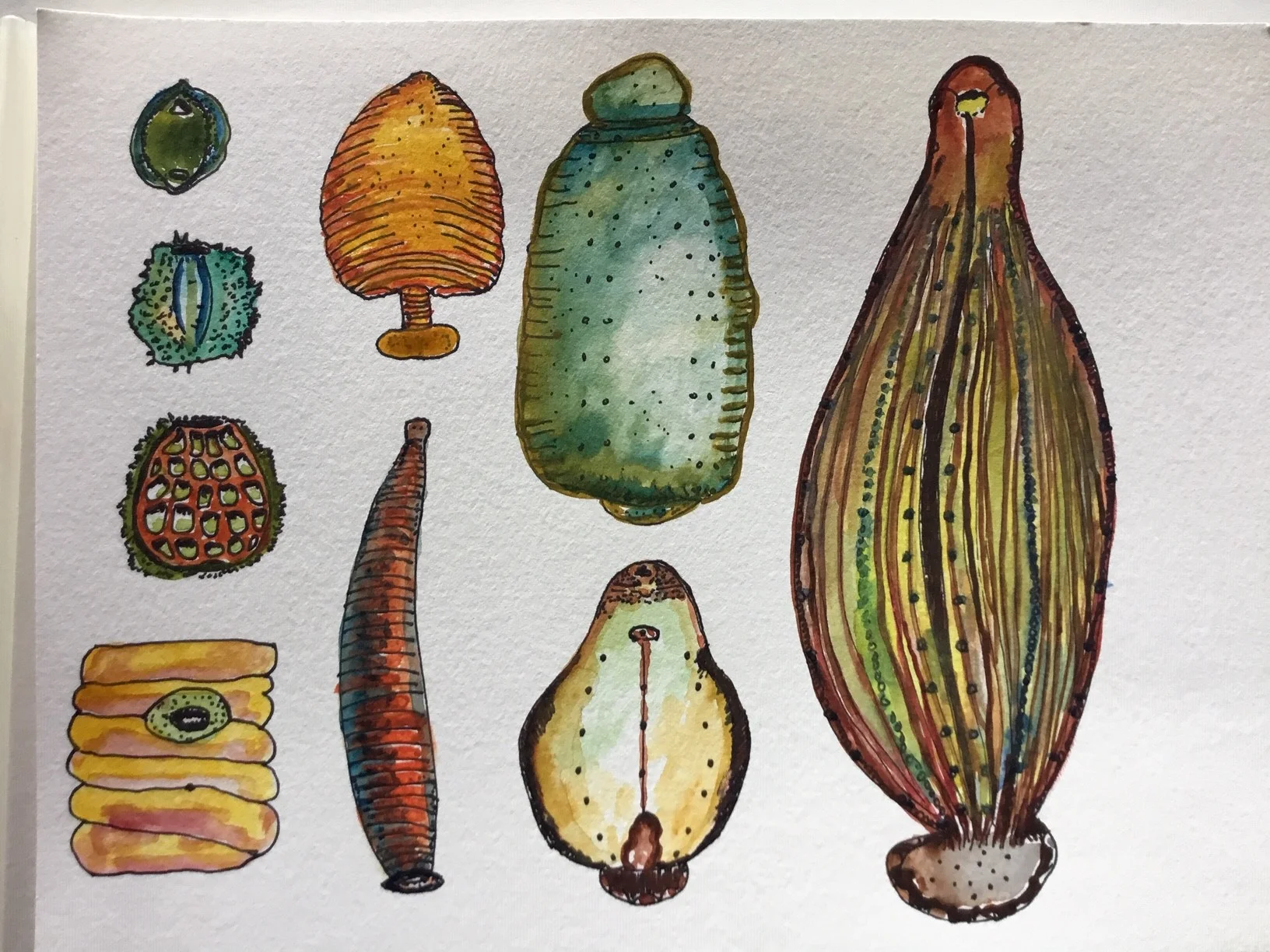
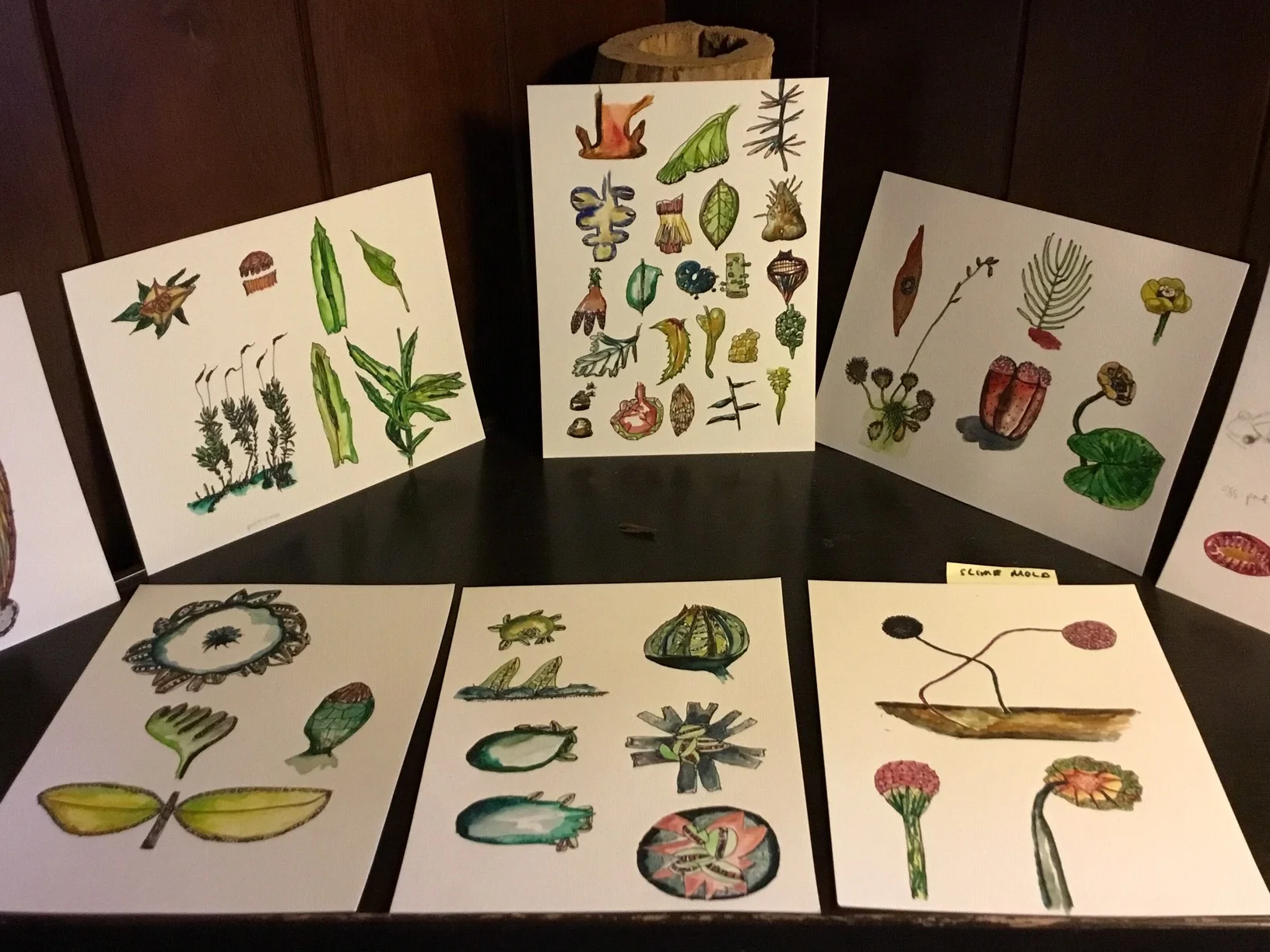
Drawing from photographs I took on land and water, and using the books that were available to me, I created over twenty-five ink and watercolors. My artwork has benefitted from this uninterrupted time to explore a region of our country that is rich with botanical species and in a beautiful setting. I felt as if my senses were heightened. I could see, hear and smell more clearly. I heard the calls of phoebes, gulls, loons, sandhill cranes, cicadas and frogs; the geese scratching in the high grass and fish jumping in the evening. The greens of moss and ferns were too numerous to count. I came upon so many varieties of slime mold and fungi, ranging from oozing pale yellows to chestnut browns and nearly florescent orange. The water in the lakes and rivers was yellow-orange in color. On my last afternoon on Ives lake I studied the leeches that were at the shoreline under the porch. They appeared to be the same flat, brown shape as the leaves floating in the water. The difference was that these shapes would arch their bodies in search of food. My residency was made up of many of these kinds of double takes. On first observation I was recognizing something familiar. On the second look, I realized it was entirely new.

View fullsize horsehair_worm.jpg
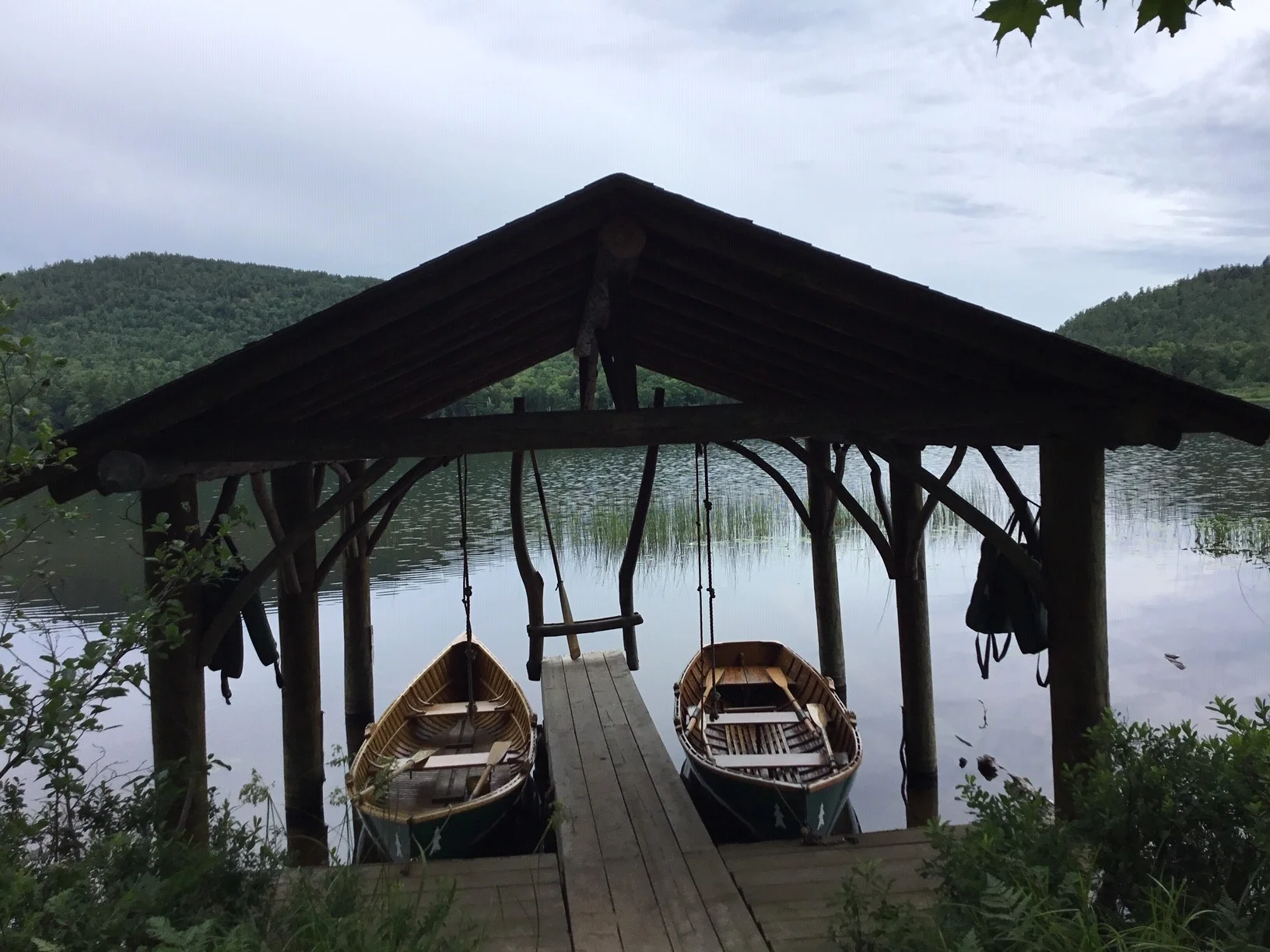
View fullsize boathouse_pine.jpg
View fullsize eggpad.jpg
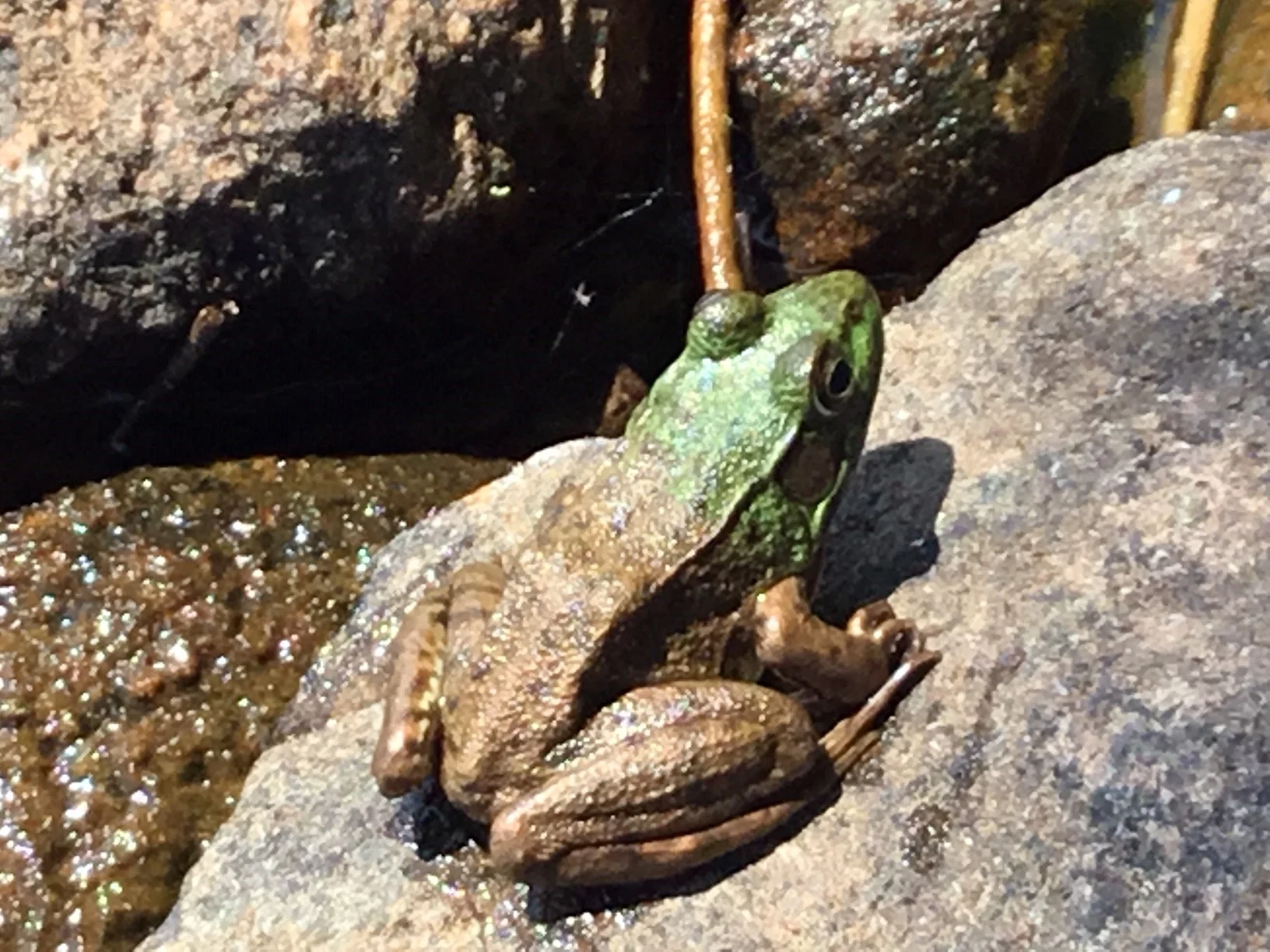
View fullsize frog_iveslake.jpg
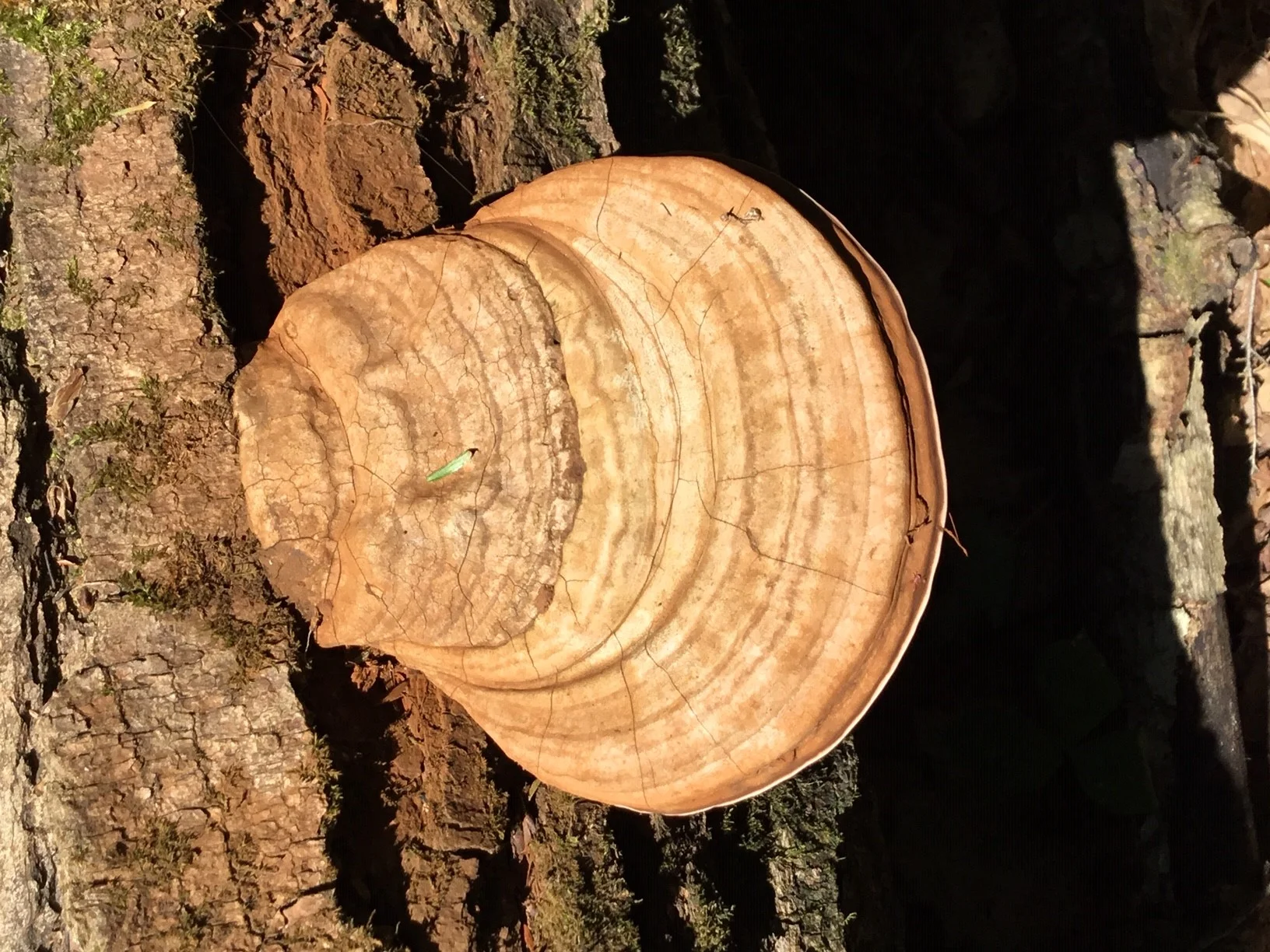
View fullsize fungi.jpg
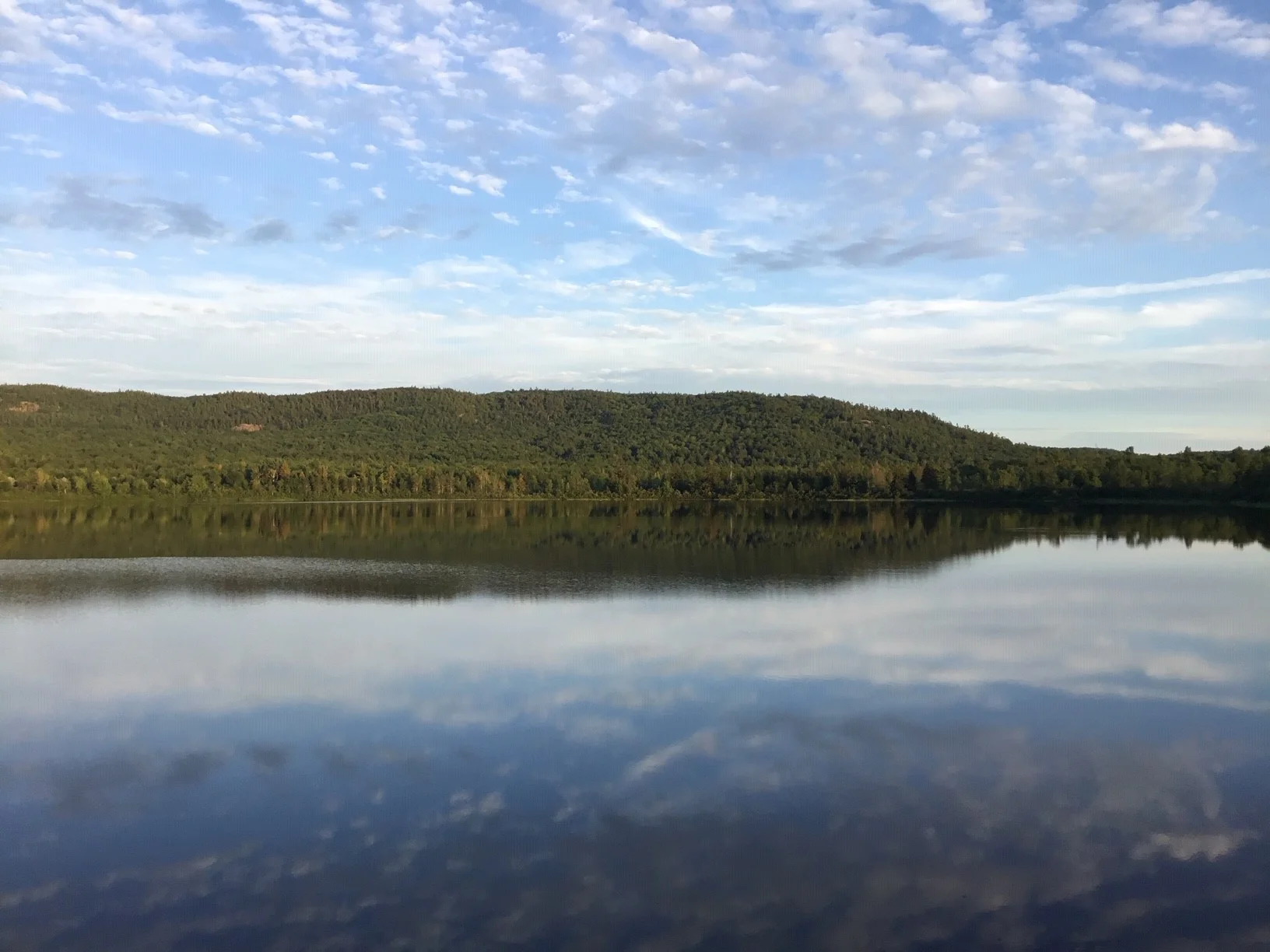
View fullsize ives_Lake.jpg
View fullsize leech.jpg
View fullsize water_shield.jpg
View fullsize watercolors.jpg
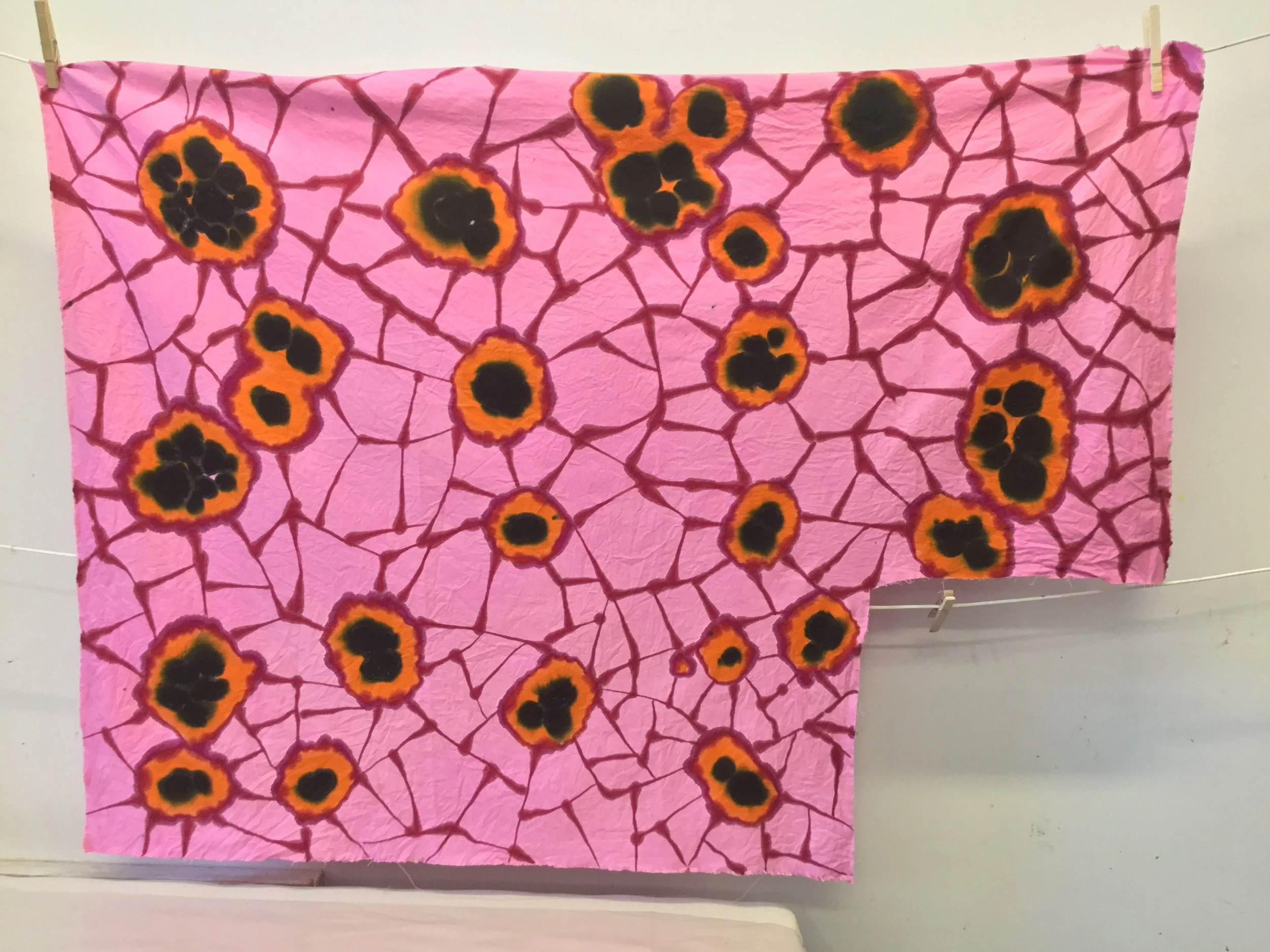
Hand-dyed cotton inspired by pollen, 2018

Hand-dyed cotton inspired by pollen, 2018

Artist-in-Residence at Lillstreet Art Center: Pollen, Leaves, Seeds and Trees

February 9, 2018
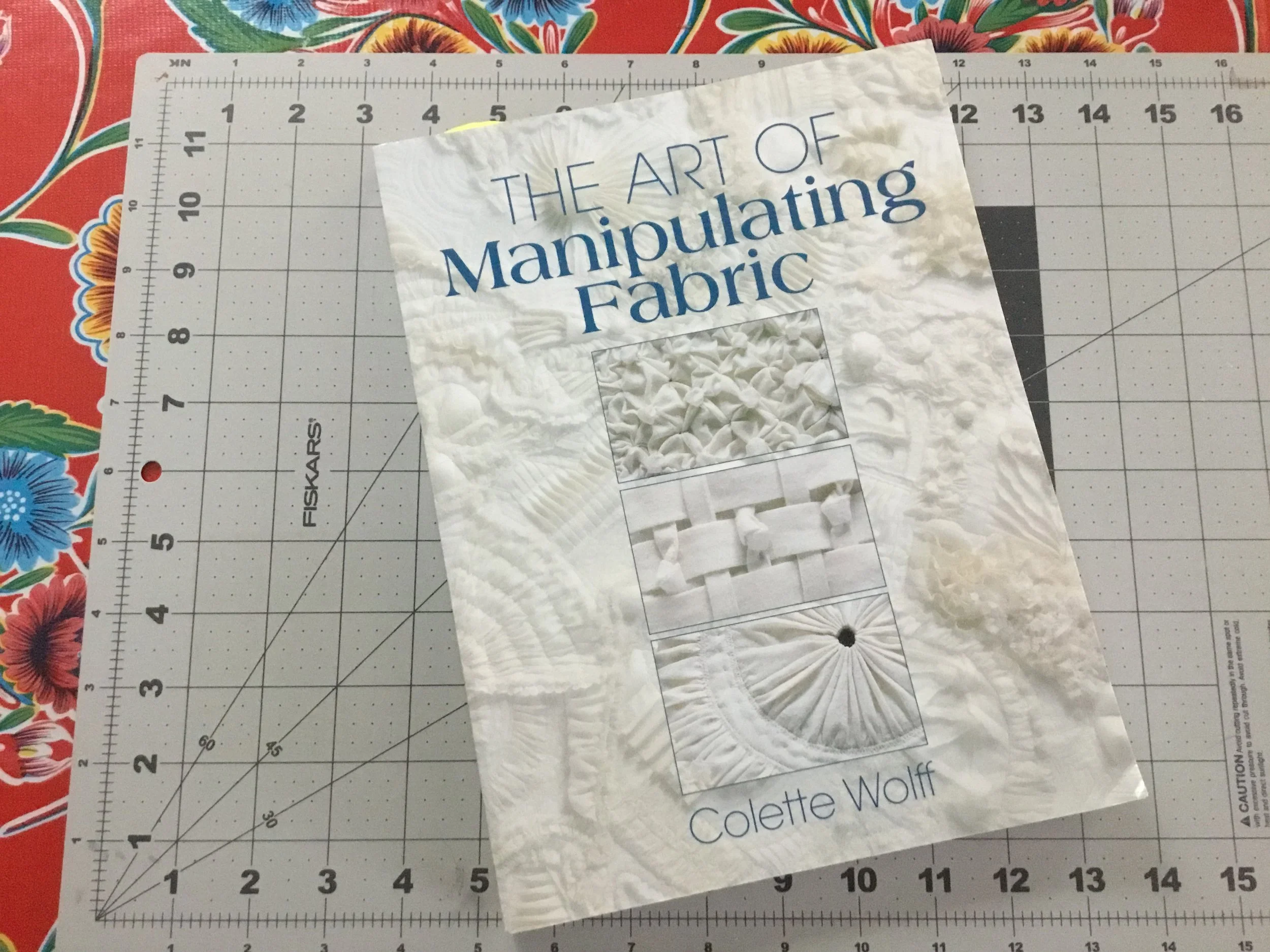
The Art of Manipulating Fabric, by Colette Wolff

The Art of Manipulating Fabric, by Colette Wolff

There are many wonderful upsides to being an Artist-in-Residence at Lillstreet Art Center (LAC). In addition to having 24-hour access to the silkscreen and sewing studios, which includes space to create, display and store my work, I can take classes for free at LAC in any department. Though I have yet to take any classes outside of the Textiles department, I have had a full schedule taking classes in sewing, dye and print techniques. The faculty are thoughtful, talented professionals from diverse backgrounds and the ongoing dialogue with this community has contributed to my growth as an artist.

I've spent the past six months thinking of my time as an artist-in-residence in the Textiles department as very similar to traveling abroad. I'm a bit out of my comfort zone, and the languages related to the media and methods are different from what I am used to. Sometimes I act like I know where I am and sometimes I really do know where I am. 

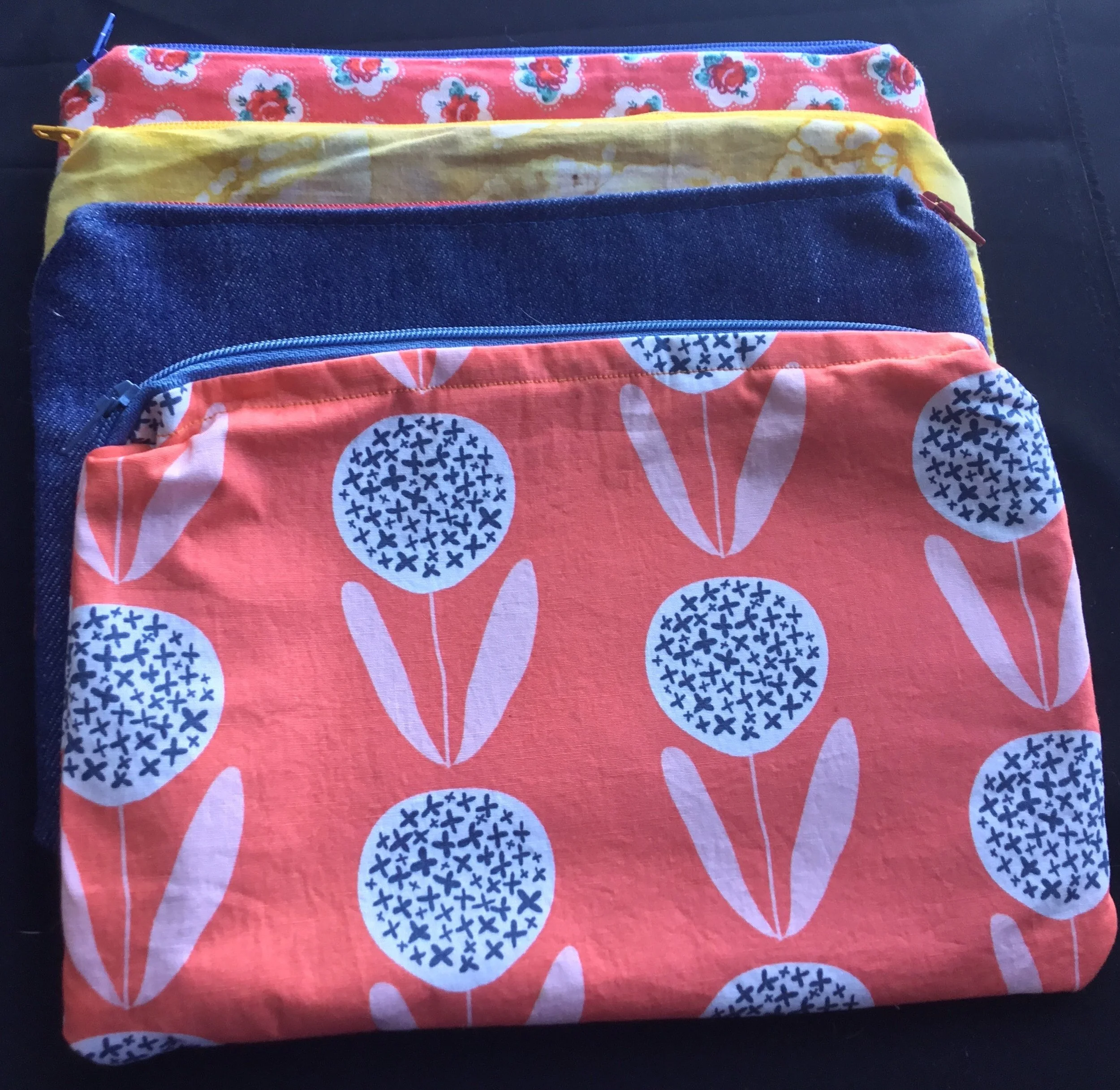
Zippered bags made in Zippers and Buttons class at Lillstreet Art Center, 2017

Zippered bags made in Zippers and Buttons class at Lillstreet Art Center, 2017

I began my studio work creating leaf-shaped quilts and playing with the formal aspects of the top and underside surfaces of leaves. I am interested in galls that form on leaves and the differences in their color and texture.

Sewing instructor Nico Gardner introduced me to The Art of Manipulating Fabric written by Colette Wolff. Though I have barely scratched the surface of mastering these sewing skills I was taken with the black and white photos that described completed pleats, godets, puffs, flounce and smocking and wondered how I can incorporate these forms and techniques into the textile pieces I am creating. I began sewing on large-scale, full sheets and then had to step back and try some more modest pieces, so that I could better see my progress


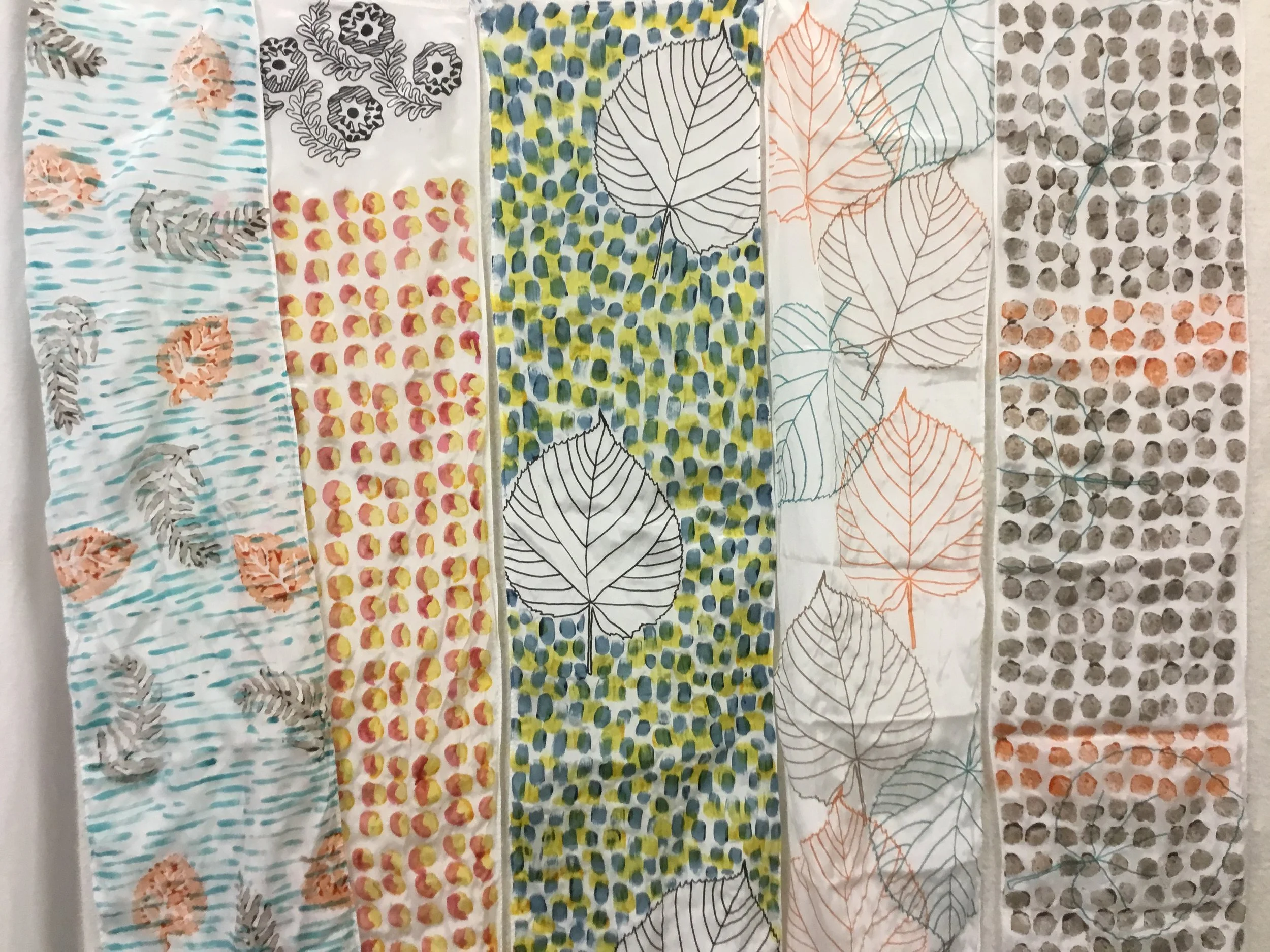
Silk scarves, painted and silkscreen with dye. 8 x 54"  2018

Silk scarves, painted and silkscreen with dye. 8 x 54"  2018

My exploration of dye techniques on cotton/silk blends, mostly scarves, use dye to draw and paint textures and patterns to work out compositions for larger pieces.  I've explored printing thinned dye on wet fabric and printing from carved styrofoam blocks to create surface design patterns.


AIR_9.jpg

These new surface design patterns are then incorporated into three-dimensional objects. The designs are cut and sewn to create re-imagined pollen grains. 


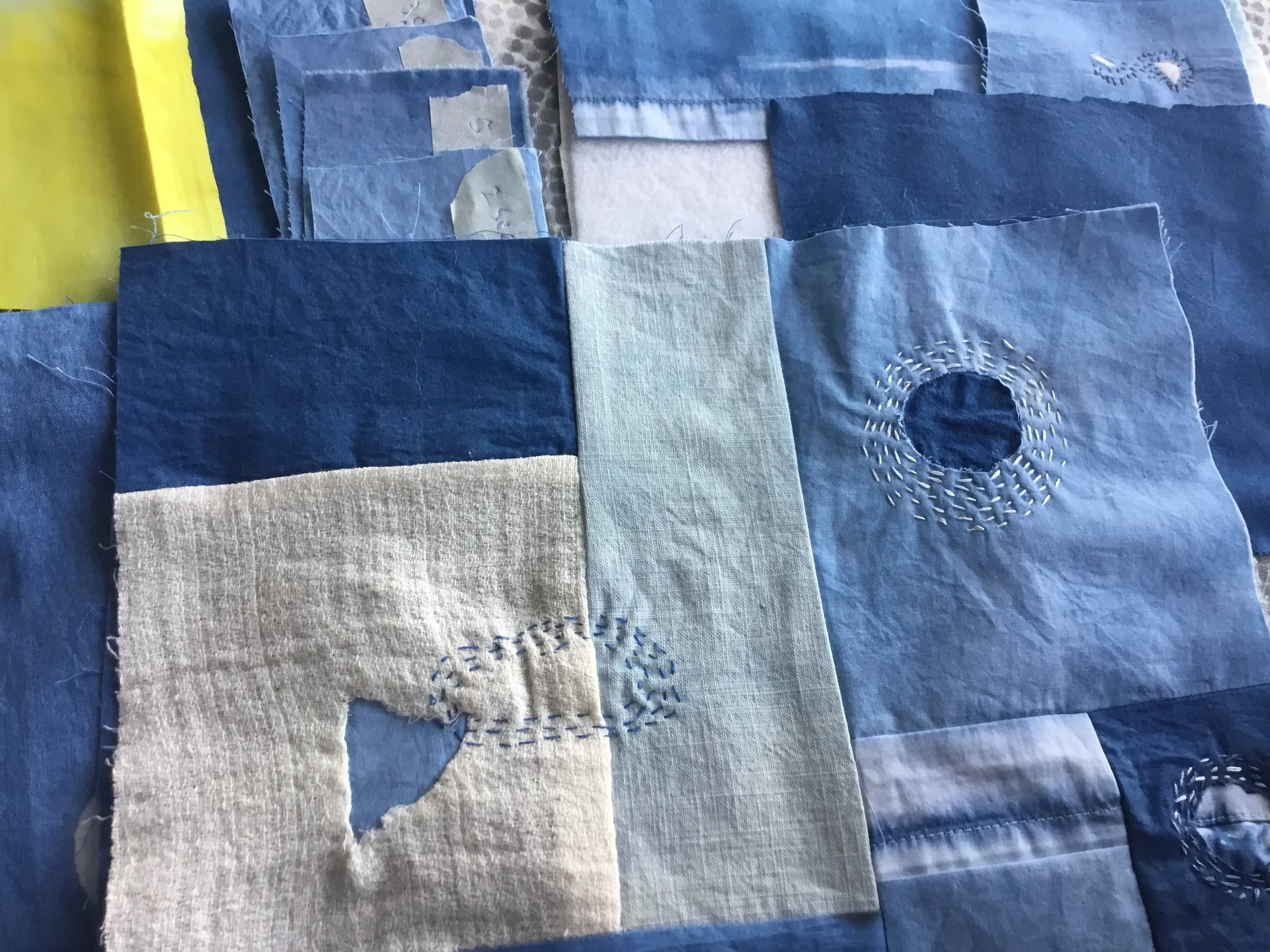
Indigo dye cotton and linen with Boro stitching, 2018

Indigo dye cotton and linen with Boro stitching, 2018

I have taken two classes with LAC faculty Akemi Cohn, Indigo dye with Katazome and Indigo dye and Boro stitching. Akemi is an excellent instructor and I have learned both about the historical and cultural aspects of indigo as well as the artistic processes. One of the joys of taking Akemi's courses is having a front row seat to the incredible samples and completed pieces she shares with her students. 


Lichen, Shot cotton, designed by Kaffe Fassett, Oak Fabrics, Chicago, IL

Lichen, Shot cotton, designed by Kaffe Fassett, Oak Fabrics, Chicago, IL

When I travel abroad I am constantly noticing similarities and differences while I navigate a new place: the palette, the architecture, texture, smells and sounds. I can't help but feel humbled by what I don't know. In this new terrain of textiles, I am struck often by all I have learned in such a short amount of time.

The other day, while I was salivating over textiles at Oak Fabrics, the owner shared the name of the designer of these textiles, Kaffe Fassett. I had never heard of Fassett. The shot cotton textiles that I am especially smitten with, combine two different colored threads and have a depth and richness that reminds me of painted surfaces. 

Tags textiles, painting, printmaking, artist-in-residence, lillstreet, textilesdepartment, chicago, dye, indigo, sewing, botanical, pollen, leaves, trees, seeds

Latest Posts

Art_bumble on Instagram

Great group of students today @mortonarb for Natural Dyes: Layering Color - Indigo + Marigold

#mortonarboretum #indigo #marigold #naturaldyes #colorstudies #shibori #layeringcolor #botanical
Shipping a few hand-painted and silkscreen-printed scarves to @gallery2_alfred 
@lencurran 

#textiles #silkscreen #handdyed #cotton #silk
A few examples of student’s Logwood natural dye experiments on silk @textilesatlillstreet @lillstreet 💜👏🏼

#naturaldye #colorstudies #logwood #silk #textiles #shibori
Spring garden🌱

#westernsuburbs #springgarden #peony #dogwood #sedge #redbud #pear #botanical
A few more from my time in Charlotte @rothrockristin 💙💚💙
Thanks for the tour of the Greenhouses and Reedy Creek Nature Center. 🤩🌱
Feel lucky to be @unccharlotte with @rothrockristin to share indigo and shibori with very engaged students! Thanks for having me! 💙💙🪣🌀

#unccart #indigo #naturaldye #shibori #resist #surfacedesign #colorstudies
A peek at student’s work from today’s Indigo Extravaganza @lillstreet @textilesatlillstreet 🌀💙🪣

#shibori #indigo #naturaldye #textiles #silk #cotton #communitystudio #lillstreet #colorstudies #surfacedesign
We saw so much great work @expochicago including this piece by Celeste Rapone @celesterapone @corbettvsdempsey 
Booth 223

#expochicago #booth223 #celesterapone #painting
Giving a shout out to our neighbor and friend @bv_photography_1 who took this sweet photo of Louis for his portfolio. 
If you are looking for a photographer to take family photos, upcoming graduation, special events, professional headshots or documen
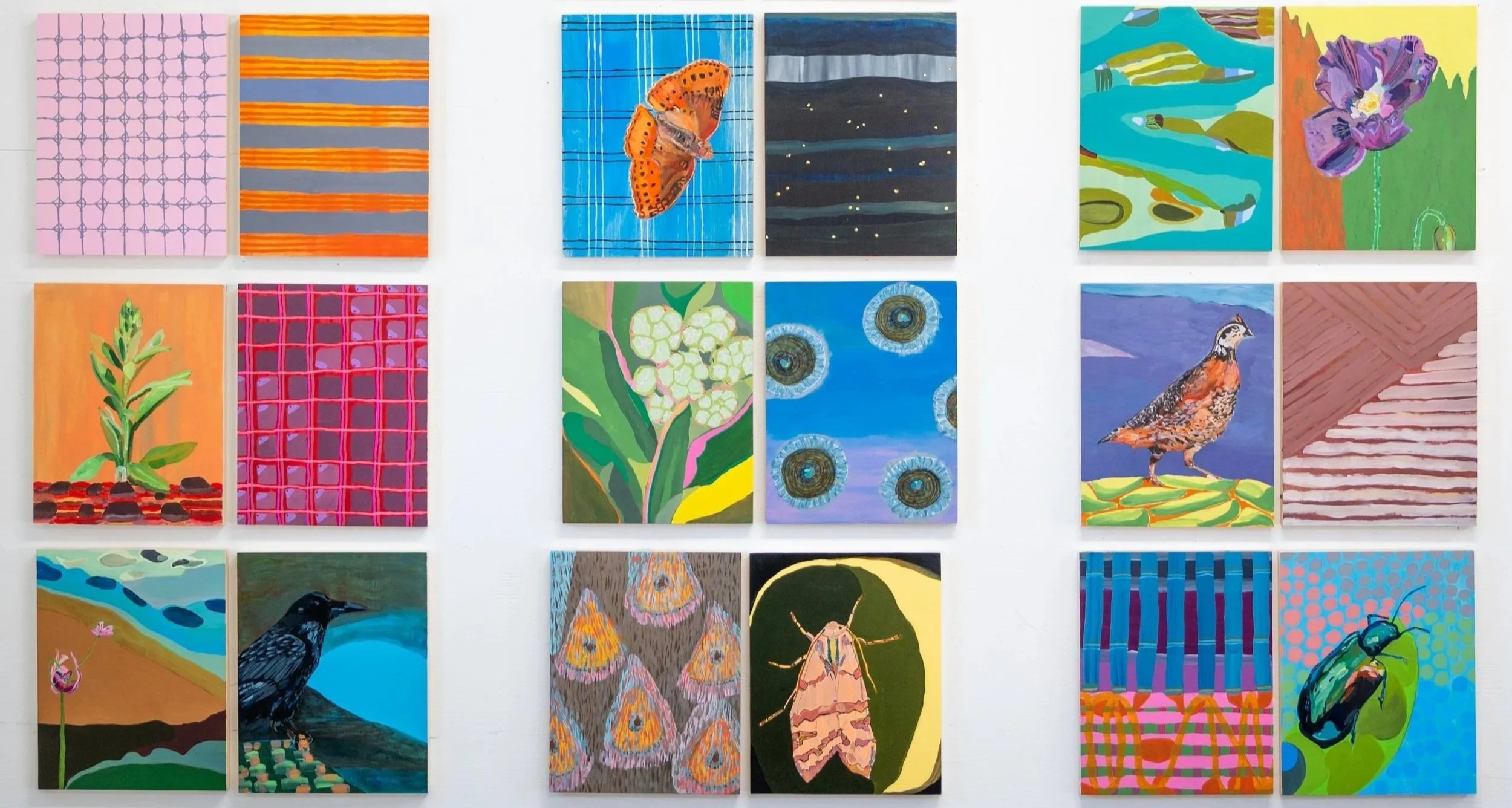
April: in the studio and in the garden. Acrylic on wood panel. 8 x 10”. Dogwood bud.

#botanicals #aquaticplants #dogwood #shapesofthings #colorstudies #painting